
You’ve thought about it a hundred times. Maybe you even bought leggings for it. But every time you try to start working out, you either don’t know where to begin, feel too self-conscious to go to a gym, or start too hard and quit after three days. Here’s the good news: you don’t need a gym membership, expensive equipment, or hours of free time to get fit. You need a plan that’s actually built for a real beginner one that respects your body, your schedule, and your confidence level. That’s exactly what this guide gives you.
Table of Contents
A Common Beginner Pattern
Why so many women quit before seeing results.
One pattern I’ve seen repeatedly is that many beginners try to work out for 40 minutes or more every day. Within just a few days, they’re exhausted, sore, and lose motivation.
Starting with just 15–20 minutes, three times a week is usually far more sustainable. It gives your body time to adapt, helps you build consistency, and makes it much more likely that you’ll stick with your routine long enough to see real results.
Why Working Out at Home Is a Smart Choice for Beginners

Home workouts have quietly become the preferred starting point for millions of women, and not just because they’re convenient.
No intimidation factor.
No one is watching you learn a squat for the first time. For many women, the fear of being judged in a gym is the single biggest reason they never start at all training at home removes that barrier completely.
Zero commute, zero cost.
You save the membership fee and the 20 minutes each way, which means the time excuse disappears too.
Total flexibility.
Train at 6 a.m. in your pajamas or at 9 p.m. after the kids are asleep. A home workout for women fits around real life instead of forcing real life to fit around a gym schedule.
Privacy to build confidence.
Many women use home workouts as a bridge before ever setting foot in a gym and some never need the gym at all, because a well-structured bodyweight routine can deliver real strength and fat-loss results.
You control the environment.
Your own music, your own pace, your own mat. No waiting for equipment, no rushing because someone else wants the machine.
Research from the American Heart Association recommends at least 150 minutes of moderate activity per week for adults, and a structured home routine makes hitting that number far more realistic than trying to squeeze in gym trips around work, family, and everything else on your plate.
There’s also a psychological benefit that rarely gets mentioned: starting at home lowers the stakes. If a gym visit feels like a big, intimidating event, it’s easy to talk yourself out of it on a tired day. A 20-minute home workout, on the other hand, feels small and manageable enough that you’re far more likely to actually show up for it and showing up consistently is what produces results, not the location where you train. Many women who eventually do join a gym say their home workout phase was what gave them the strength, confidence, and basic movement knowledge to walk in without feeling lost.
What You Actually Need Before You Start
This is shorter than you think:
- A small clear space (about the size of a yoga mat)
- Comfortable clothes you can move in
- A bottle of water
- Optional: a yoga mat, a chair or low table, and a phone timer
You do not need dumbbells, resistance bands, or a fitness app subscription to get real results as a beginner. Your bodyweight is enough to build strength, improve endurance, and start reshaping your body composition in the first few months of training.
How to Set Up a Simple Home Workout Space
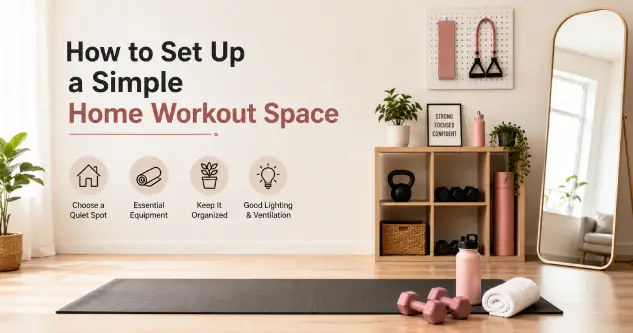
You don’t need a home gym you need a corner that consistently tells your brain this is where I train. That signal alone makes it easier to show up.
Pick one consistent spot, even if it’s just a cleared 6×6 foot area in your living room or bedroom. Repetition of location builds habit faster than you’d expect.
Check the floor. A yoga mat over hardwood or tile gives you grip and cushions your knees and wrists during floor exercises. Avoid thick, unstable carpet that shifts under your feet during squats or lunges.
Clear tripping hazards cables, low furniture corners, loose rugs before you start, especially if your workout includes any movement that shifts your weight quickly.
Keep water within reach so you’re not tempted to wander off mid-circuit and lose momentum.
Good lighting and airflow make a bigger difference than people expect; a stuffy, dim room makes a workout feel twice as hard as it needs to.
Put your phone on do-not-disturb for the 20 minutes you’re training, unless you’re using it as a timer. Notifications are one of the most common reasons home workouts get cut short.
None of this needs to be permanent or expensive. A mat you roll out and put away afterward is enough what matters is that the space is ready and predictable every time you decide to train.
Best Time to Work Out at Home
One question almost every beginner asks is: “What’s the best time of day to work out?” The honest answer is that the best time is the time you’ll actually stick to but there are real differences worth knowing about, so you can choose what fits your body and your schedule.
Morning Workouts
Training first thing in the morning, before your day fills up with responsibilities, is one of the most reliable ways to guarantee consistency. Nothing has had the chance to go wrong yet, no meeting has run late, no child has needed something urgent. Morning workouts are also linked to better mood and energy throughout the day, since exercise triggers the release of endorphins early on.
The downside: your body is naturally stiffer first thing in the morning, so a slightly longer warm-up matters more here than at any other time of day.
Afternoon Workouts
For many women, the early-to-mid afternoon is when body temperature and muscle flexibility peak, which can make exercises feel easier and reduce the risk of strain. If you work from home or have a flexible schedule, a midday session can also work as a helpful mental reset that breaks up a long day.
Evening Workouts
Evening sessions work well for women whose mornings are simply too packed to spare 20 minutes. Training in the evening can also help release the tension built up over the day. The one caution: intense workouts too close to bedtime can make it harder to fall asleep for some people, so if you’re an evening exerciser, try to finish at least 1–2 hours before you go to bed.
So, Which Is Best?
There’s no universally correct answer a home workout for women only works if it happens consistently. Pick the time slot you can protect from interruptions most days of the week, and treat it like a non-negotiable appointment with yourself.
Step 1: Warm Up Every Single Time (3 Minutes)
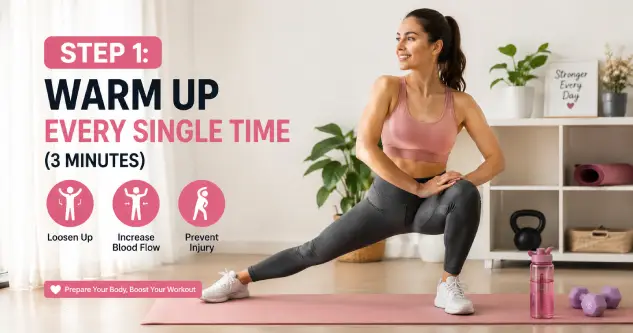
This is the step most beginners skip and it’s exactly why so many quit after week one with sore knees or a strained back. A short warm-up raises your heart rate and prepares your joints, so the actual workout feels easier and safer.
| Warm-Up Move | Time |
| March in place | 45 seconds |
| Arm circles (forward + backward) | 30 seconds |
| Slow bodyweight squats | 10 reps |
| Hip circles | 30 seconds each side |
Step 2: The Only 5 Exercises You Need to Start
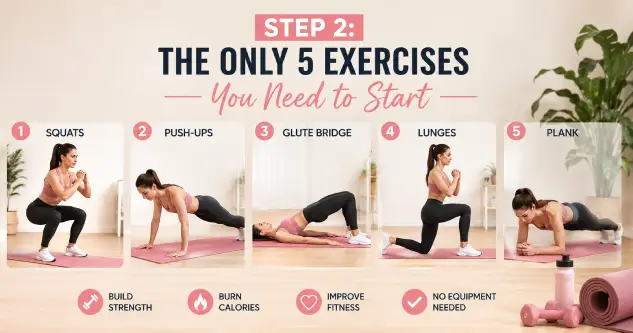
You don’t need 20 different exercises to see results. You need 5 that work your whole body, done consistently. Here’s your starter circuit:
| Exercise | Reps / Time | What It Works |
| Bodyweight Squats | 15 reps | Legs and glutes |
| Incline Push-Ups (hands on a table or wall) | 10 reps | Chest, arms, shoulders |
| Glute Bridges | 15 reps | Glutes and lower back |
| Standing Knee Lifts | 20 reps (10 per side) | Core and balance |
| Forearm Plank | 20–30 second hold | Full core |
How to do it: Complete all 5 exercises back to back, rest for 60–90 seconds, then repeat for 2–3 total rounds. That’s it 15 to 20 minutes, done.
If a move feels too hard, reduce the reps rather than skipping it entirely. If it starts to feel easy after two weeks, use the progression methods in the next section.
Step 3: Follow a Simple Weekly Schedule
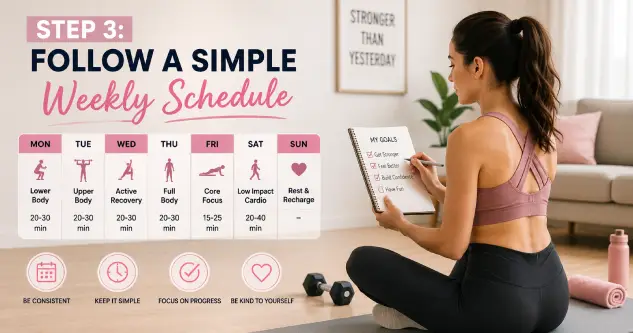
Consistency beats intensity every time, especially in your first month. Here’s a beginner-friendly week for a home workout routine:
| Day | Focus | Duration |
| Monday | Full-body strength (the 5-exercise circuit) | 20 min |
| Tuesday | Active recovery — walk or gentle stretching | 10–15 min |
| Wednesday | Full-body strength | 20 min |
| Thursday | Rest or light mobility work | — |
| Friday | Full-body strength | 20 min |
| Saturday | Optional: walk, dance, or yoga for fun | 15–20 min |
| Sunday | Full rest | — |
Three structured sessions a week is enough to build real strength as a beginner. Your muscles don’t get stronger during the workout they get stronger during the rest between workouts.
Download Your Free Beginner Workout Plan
Ready to get started? Download this printable 7-Day Home Workout Plan for Women and keep it on your phone or print it out to follow your workouts without opening this article every time.
Step 4: Cool Down and Stretch (3 Minutes)
After each session, gently stretch your quads, hamstrings, chest, and shoulders, holding each stretch for 20–30 seconds. This helps your heart rate return to normal and reduces next-day soreness.
What to Eat Before and After a Workout
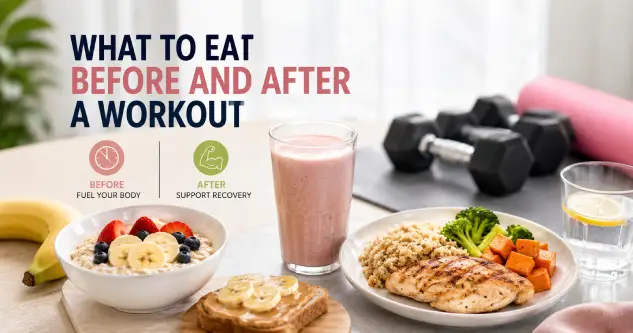
Nutrition is half the equation when you start working out at home, and getting it wrong is one of the fastest ways to feel exhausted, dizzy, or unmotivated within the first two weeks.
Before Your Workout
You don’t need a big meal you need enough fuel to avoid feeling drained mid-circuit, without feeling heavy.
30–60 minutes before training: a small snack combining carbohydrates and a little protein, such as a banana with a spoon of peanut butter, a slice of toast with honey, or plain yogurt with fruit.
If you’re training first thing in the morning and don’t feel like eating, that’s fine for a short 20minute bodyweight session — just make sure you drink a full glass of water beforehand.
Avoid heavy, greasy, or very high-fiber meals right before training, since they can cause cramping or nausea during movement.
After Your Workout
This is the window your body uses to repair muscle and restock energy, so don’t skip it even if you’re not very hungry.
Within 30–45 minutes after finishing: aim for a combination of protein and carbohydrates — for example, eggs with whole-grain toast, a protein smoothie with fruit, or grilled chicken with rice.
Protein helps repair the small muscle fibers broken down during strength training, which is exactly how muscles get firmer and stronger over time.
Carbohydrates replenish the energy stores your muscles used during the session, so you don’t feel wiped out for the rest of the day.
Hydration matters as much as food. Aim to replace fluids lost through sweat with water, and add electrolytes if your session was longer or more intense than usual.
Sample Meal and Snack Ideas
If you’re not sure what a small carb-and-protein snack actually looks like in practice, here are simple, realistic options:
| Timing | Easy Options |
| Before workout (30– 60 min) | Banana with a spoon of peanut butter, plain toast with honey, a small bowl of oats, or yogurt with fruit |
| After workout (30–45 min) | Eggs with whole-grain toast, grilled chicken with rice, a protein smoothie with fruit and milk, or lentils with vegetables |
| Anytime hydration | Water, or water with a pinch of salt and lemon after a longer or sweatier session |
None of these need to be complicated or expensive the goal is simply to make sure your body has fuel going in and material to repair with coming out.
A Simple Rule to Remember
If your goal is general fitness and toning, you don’t need to overthink meal timing a balanced diet across the whole day matters more than the exact minute you eat. But if you’re training in the morning on an empty stomach and feeling lightheaded, that’s your body telling you it needs a small snack beforehand.
How to Increase Workout Intensity Gradually
One of the most common beginner mistakes is either never progressing at all, or trying to progress too fast and getting hurt. The safest and most effective approach is called progressive overload gradually asking your body to do slightly more over time.
Here’s how to apply it to a home workout for women, step by step, roughly every 1–2 weeks:
- Add more reps first. If you’re currently doing 15 squats, move to 18–20 before changing anything else. This is the gentlest form of progression.
- Add an extra round. Once 2 rounds of the circuit feel manageable, add a third round rather than adding new, unfamiliar movements.
- Slow down each rep. Taking 3–4 seconds to lower into a squat or push-up (instead of moving quickly) makes the same exercise noticeably harder without adding any risk.
- Shorten your rest time. Cutting rest between rounds from 90 seconds to 60 seconds increases the cardiovascular demand of the same exact workout.
- Add resistance. Once bodyweight squats and push-ups feel easy for 3 full rounds, introduce a resistance band or a pair of light dumbbells — this is usually around week 6 to 8 for most beginners.
- Progress the exercise itself. For example, move from incline push-ups (hands on a table) to pushups on the floor with knees down, and eventually to full push-ups.
The golden rule: only change one variable at a time. If you add more reps, more weight, and less rest all in the same week, you won’t be able to tell what’s actually challenging your body and you raise your risk of injury or burnout.
A 4-Week Progression Overview
To make this concrete, here’s roughly how a beginner’s first month might look if she follows the progression rules above:
| Week | What Changes | Example |
| Week 1–2 | Learn the movements, focus purely on form | 2 rounds of the 5exercise circuit, 90 sec rest |
| Week 3 | Add reps | 18–20 squats, 12 push-ups, keep 2 rounds |
| Week | What Changes | Example |
| Week 4 | Add a third round | 3 rounds of the full circuit, 90 sec rest |
| Week 5–6 | Shorten rest slightly | 3 rounds, 60–75 sec rest |
| Week 7–8 | Introduce light resistance or harder variations | Add a resistance band, or move to floor push-ups |
This isn’t a rigid rulebook — some women will move faster, others slower, and that’s completely normal. What matters is that each change is small enough that your form never breaks down, and gradual enough that your joints and connective tissue have time to adapt alongside your muscles.
Common Mistakes Beginners Make (and How to Avoid Them)
Going too hard on day one. Motivation is high at the start, but your body needs time to adapt. Start at 70% effort.
Skipping rest days. Rest isn’t laziness — it’s when your muscles actually repair and grow.
Comparing your week 1 to someone else’s year 3.
Progress is personal. Track your own numbers,
not someone else’s.
No warm-up or cool-down. Skipping these is the fastest route to an injury that stops your progress entirely.
Expecting visible changes in a week. Most women notice more energy and better mood within 7–10 days, and visible physical changes within 4–6 weeks of consistency.
Training without any structure. Doing random exercises every day with no repeated plan makes it impossible to know if you’re actually progressing, since you have nothing consistent to measure against.
Quitting after one missed week. Life happens a sick child, a busy work week, a vacation. Missing several days doesn’t erase your progress. The only real setback is treating one missed week as a reason to stop entirely instead of simply restarting.
Ignoring how you feel outside the workout. Better sleep, steadier mood, and more energy during the day are just as much a sign of progress as a stronger squat, and beginners who only judge themselves by the mirror often quit before these benefits have a chance to show up.
Common Mistakes While Working Out at Home Specifically
Beyond the general beginner mistakes above, home workouts come with their own unique set of pitfalls that gym-goers don’t usually deal with mostly because there’s no trainer or mirror nearby to correct you.
Training on a slippery or uneven surface. A hardwood floor without a mat, or carpet that’s too soft and unstable, can throw off your balance during squats and lunges. Always train on a flat, non-slip surface.
Using unstable furniture for support. Leaning on a wobbly chair or a low table during push-ups or step-ups is a common cause of falls at home. Test that anything you use as equipment is sturdy enough to bear your weight.
No mirror or visual feedback on form. Without a mirror, it’s easy to let your knees cave inward during squats or let your back sag during a plank without noticing. Filming yourself once a week on your phone is a simple fix that catches form issues early.
Too many distractions. Training in front of the TV or checking your phone between every set slows your pace and increases the odds of losing focus on your form. Keep your workout space as distraction-free as possible.
Working out right after eating a large meal.
Because there’s no commute time between “finishing lunch” and “starting your workout” at home, some women jump straight into training on a full stomach, which leads to cramping and discomfort.
Not changing your clothes or shoes. Training in loose house clothes or socks on a smooth floor increases the risk of slipping during dynamic movements. Wear proper athletic shoes with grip, even at home.
Inconsistent workout space. Constantly changing where you train (living room one day, bedroom the next) makes it harder to build the mental habit and routine that comes with a dedicated space.
Copying advanced online workouts too soon. Social media is full of fast-paced, high-intensity home workout videos designed for people who’ve been training for years. Following along as a complete beginner often means rushed reps, poor form, and a much higher injury risk than a slower, structured routine like the one in this guide.
Tips to Avoid Injuries
Injury is the single biggest reason women quit home workouts in the first month not lack of motivation. Most home workout injuries are entirely preventable with a few simple habits.
Never skip the warm-up, even when you’re short on time. Cold muscles and stiff joints are far more prone to strains.
Prioritize form over reps. Five perfect squats are more valuable and safer than fifteen sloppy ones. If you’re unsure about your form, search for a short demonstration video of the specific exercise before attempting it.
Keep your core engaged during almost every exercise, especially planks and squats. A braced core protects your lower back from unnecessary strain.
Don’t lock your joints out completely at the top of a movement — keep a slight bend in your knees during squats and your elbows during push-ups to protect the joints.
Progress gradually, following the progressive overload approach above rather than jumping straight into advanced variations.
Listen to the difference between muscle fatigue and joint pain. A burning feeling in your muscles during the last few reps is normal. Sharp,
shooting, or joint-specific pain is not stop immediately if you feel this.
Stay hydrated. Dehydration contributes to muscle cramps and dizziness, both of which increase your risk of a fall or strain.
Wear proper shoes. Training barefoot or in socks on a hard floor removes the support and grip your joints need during dynamic movements like lunges or jumping jacks.
Rest when you’re sick or exhausted. Pushing through illness or extreme fatigue weakens your form and reaction time, both of which raise injury risk.
Give extra attention to your knees and lower back. These are the two areas most commonly strained by beginners doing squats, lunges, and planks with imperfect form keep your knees tracking over your toes and your spine neutral rather than arched or rounded.
Don’t train through swelling or bruising. Mild muscle soreness is normal; visible swelling, bruising, or a joint that feels unstable needs rest and, if it doesn’t improve within a few days, a conversation with a doctor or physiotherapist.
Warm up longer in cooler weather or first thing in the morning. Cold muscles and stiff joints need a bit more time to loosen up before they’re ready for full-effort movement.
Signs Your Home Workout Program Is Working
Because you don’t have a trainer checking in on you, it’s easy to lose confidence in your progress simply because you can’t see it happening day to day. Here are the real signs beyond the mirror that your home workout for women is actually working:
Daily tasks feel easier. Carrying groceries, climbing stairs, or picking up your kids feels noticeably less tiring than it did a month ago.
You recover faster between sets. If you used to need the full 90 seconds of rest and now feel ready at 60, your cardiovascular fitness is improving.
Your form feels more natural. Movements that felt awkward or wobbly in week one like balancing during a knee lift start to feel controlled and automatic.
You’re sleeping better. Regular moderate exercise is strongly linked to improved sleep quality within the first few weeks of consistency.
Your mood is more stable. Many women notice reduced stress and steadier energy throughout the day well before they notice any physical changes.
Clothes fit differently, even if the number on the scale hasn’t moved much this usually reflects a shift in body composition, with muscle replacing some fat.
You genuinely want to train, or at least don’t dread it. When a habit stops requiring willpower and starts feeling like part of your normal routine, that’s one of the clearest signs it’s sticking.
You can do more than you could before an extra rep, an extra round, or a longer plank hold. Any measurable improvement, however small, is proof the program is working.
Track at least two or three of these signs weekly rather than relying only on the scale, which can stay flat for weeks even while real progress is happening underneath the surface. A simple weekly check-in even just three lines in a notes app answering How did my energy feel this week? Did anything feel easier? Did I look forward to any session? will show you a trend line that the scale alone never can.
How to Stay Motivated Past Week Two
This is where most beginners fall off and where a little structure makes all the difference.
Track your sessions, even with a simple checklist. Seeing three checkmarks a week is motivating on its own.
Set a process goal, not just an outcome goal. Work out 3 times this week is more achievable than lose 10 pounds.
Workout at the same time each day so it becomes a habit rather than a decision you have to make daily.
Celebrate consistency, not perfection. A finished week even an imperfect one is a win.
Find a small source of accountability. This could be a friend you text after each session, a shared calendar with a partner, or simply a habit-tracking note on your phone. Accountability doesn’t need to be public to work it just needs to exist.
Prepare your workout clothes the night before if mornings are your training window. Reducing the number of decisions you have to make in the moment makes it far easier to follow through.
Reconnect with your reason. Whether it’s more energy for your kids, feeling stronger in your daily life, or simply proving to yourself that you can stick with something revisit that reason on the days motivation is low, since willpower alone rarely lasts past the second week.
Your Next Step
You don’t need the perfect plan, the perfect gear, or the perfect Monday to start. You need one workout today, in the space you’re standing in right now. Download the free 7-day home workout plan above, follow the schedule, eat to support your training, watch for the signs of progress covered in this guide, and revisit this article anytime you need a reset.
Every woman who now trains confidently at home or in a gym started exactly where you are: with zero experience, a bit of doubt, and a single first session. What separated the ones who kept going wasn’t talent, extra time, or expensive equipment.
It was a simple, repeatable plan they trusted enough to follow for a few weeks before judging the results. That’s what this guide has given you: a plan you don’t have to overthink, a way to eat that supports it, a list of mistakes to sidestep before they cost you momentum, and a way to recognize progress long before it shows up in the mirror. Starting is the hardest rep of all. You’ve already done it by reading this far now go do the first squat.
Download Your Free Beginner Workout Plan
Ready to get started? Download this printable 7-Day Home Workout Plan for Women and keep it on your phone or print it out to follow your workouts without opening this article every time.
FAQs
How many days a week should a beginner woman work out at home?
Three days a week is ideal to start. It’s enough to build strength and habit without overwhelming your body or schedule.
Do I need equipment to start working out at home?
No. Bodyweight exercises like squats, push-ups, and planks are enough to build a strong foundation in your first few months.
Can I lose weight with home workouts alone?
Yes, when combined with a reasonable diet. Home workouts build muscle and burn calories, but nutrition plays the larger role in weight loss.
How long until I see results?
Most women feel more energetic within 1–2 weeks and begin noticing physical changes like better posture and muscle tone around week 4 to 6 with consistent training.
What’s the best time of day to work out at home?
Whichever time you can protect from interruptions most consistently. Mornings help build the habit fastest, while afternoons may feel physically easier due to warmer muscles.